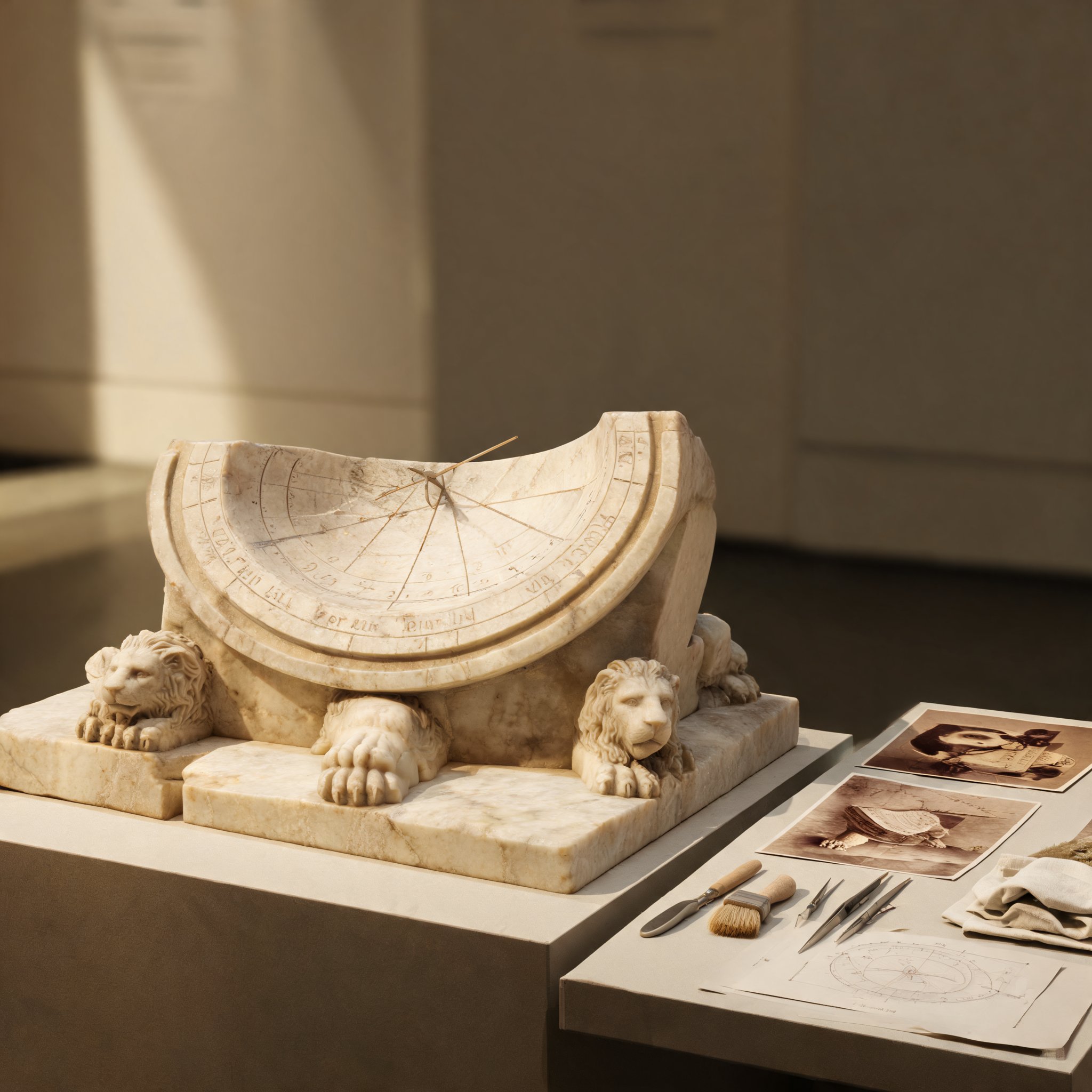
The Oreste Nardini Civic Archaeological Museum in Velletri, Italy, has returned a Roman marble sundial to public display after a restoration that used 3D printing to reconstruct a missing lion’s paw.
The artifact is a concave sundial, a type known as a hemicyclium. Conservators restored it according to the principle of reversibility: the printed paw can be removed at any time without damaging the original marble. The work restored the object’s legibility and stability after a long period of neglect, addressing both the missing appendage and the dial’s overall presentation.
Funding came from the LoveItaly association through its WeLoveItaly charity initiative. The project was carried out with the Municipality of Velletri and the Museum Grand Tour network.
Archival research shaped the treatment
Conservators Rebecca Picca Orlandi and Cecilia Balsi reconstructed the sundial’s history from documents, historical accounts and archival photographs. Their research informed the restoration plan, linking the physical treatment to a dated record of the object’s condition and location. The historical reconstruction was therefore part of the conservation process, not a separate display narrative.
Raffaella Silvestri, director of the Oreste Nardini Civic Archaeological Museum, described the restoration as a way of preserving memory. The ancients built the instrument to measure time, she said, and the work is meant to keep time from erasing their memory. Her statement linked the technical treatment to the instrument’s original purpose.
Locations and losses documented over time
The earliest known reference dates to 1790, when Carlo Antonini’s “Manual of Various Ornaments Drawn from Ancient Structures and Fragments” placed the sundial in Velletri’s Piazza di Corte, now Piazza Cesare Ottaviano Augusto. From at least 1829 it stood above the entrance of the Tempietto di Santa Maria del Sangue. It stayed there until the building became a World War I memorial in the 1930s, when the sundial was moved to City Hall. The documented locations trace the object through civic and religious settings before its move to municipal offices.
American archaeologist Sharon Gibbs measured and sketched the sundial in 1971. Her drawings showed both lion’s paws intact. Photographs in a 1972 catalog record showed one paw missing, and images published in 2003 by Nicola Severino revealed further losses on the upper part of the dial. The archival sequence therefore documents a change in condition between the early 1970s and the later images. This record provided the conservation team with a sequence against which the missing element could be understood.
The hemicyclium was designed specifically for Velletri’s latitude. It tracked the passage of time through the year as well as the hours of the day.