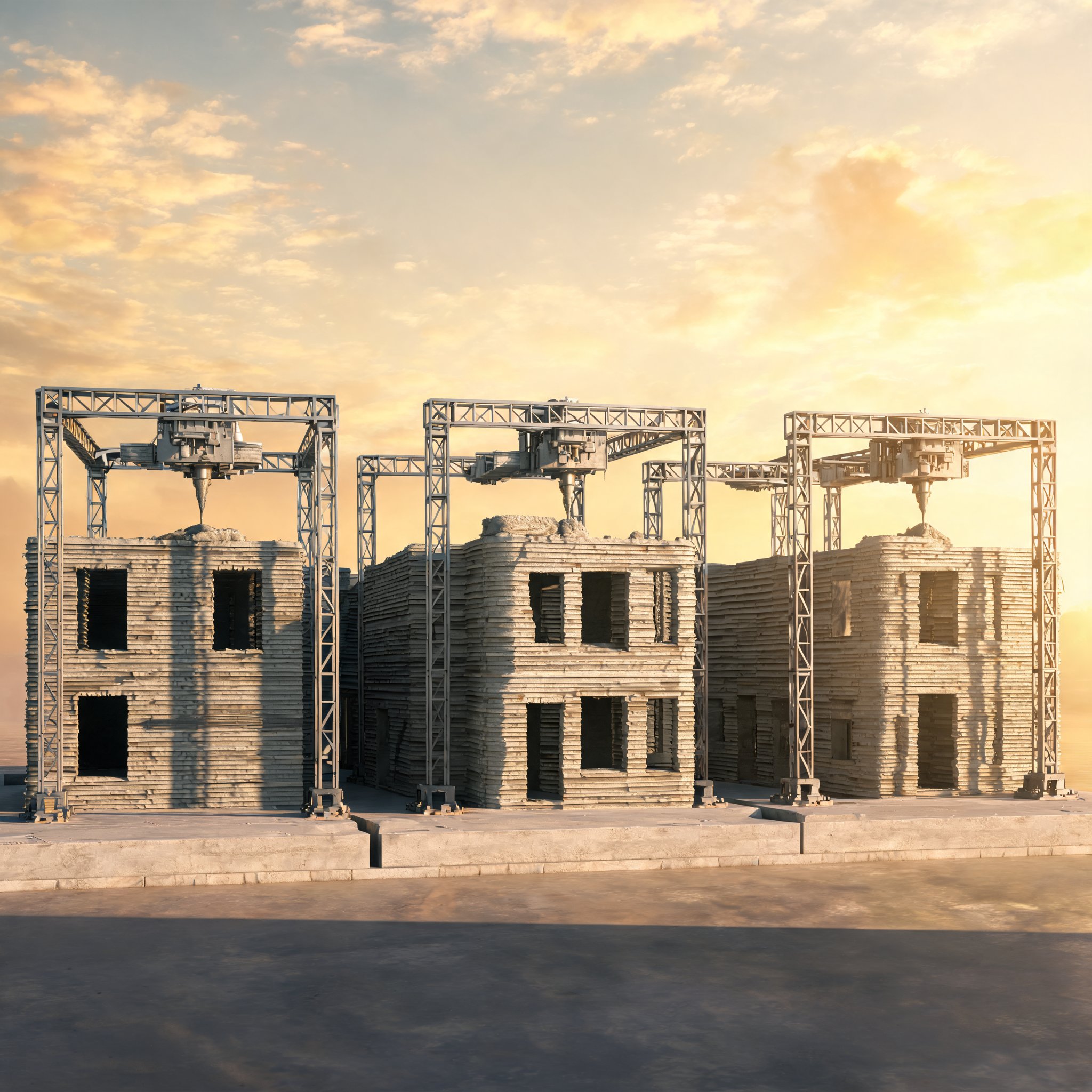
AMTG, a Florida-based builder of construction 3D printers, says three of its G2 gantry systems were used together to create the printed wall system for the Mella shopping center. The commercial project was developed by an AMTG customer, which combined the printers in a coordinated workflow. Long wall sections, openings, and architectural transitions were formed directly during printing. Using several machines allowed the project team to distribute work across the building footprint instead of depending on a single printer.
Coordinating three construction 3D printers
AMTG describes the G2 as a high-reach gantry printer built for large building projects. Its modular Cartesian structure can be configured to match building geometry and site requirements. For Mella, the three systems produced long wall sections, openings, and architectural transitions directly during printing. AMTG has not disclosed how the printers were synchronized, including whether they ran simultaneously under centralized control or followed coordinated production schedules. Even so, the project illustrates an approach to scaling construction 3D printing by deploying multiple gantry systems rather than relying on one machine.
AMTG’s role was limited to supplying the printing systems, operator training, and equipment-operation certification. Structural design, materials, and construction remained the responsibility of the customer’s qualified professionals.
AMTG’s printer families
Beyond the G2, AMTG offers three construction 3D printer families. The R-Series includes road-mobile and tracked robotic systems for rapid deployment. The G-Series covers gantry printers for on-site construction. The F-Series focuses on factory-controlled production of prefabricated components.
Construction 3D printing enters commercial projects
Construction companies are increasingly integrating 3D printing into commercial building projects. In the United States, Alquist announced an expansion of its construction 3D printing operations through a partnership involving Walmart, construction firm FMGI, and equipment supplier Hugg & Hall. The initiative covers more than a dozen commercial projects and includes equipment deployment, operator training, and technical support. It reflects a model in which contractors incorporate 3D printing into their existing construction operations.
A similar approach has appeared in Germany, where construction group Matthäi established a dedicated 3D printing division after completing a two-storey office building. Using a COBOD BOD2 printer, the company produced the building’s walls in about 105 hours, while foundations, floors, and roofing were completed with conventional methods.
Expanding reach and capacity
Other construction 3D printing projects are exploring ways to raise production capacity and extend the areas covered by automated equipment. In France, the ViliaSprint² development used a COBOD BOD2 printer to construct a three-storey, 12-apartment residential building. Its walls and load-bearing structure were printed in 34 days, compared with an initial estimate of 50 days. The project partners are planning a larger development that would involve two printers operating simultaneously.
Australian construction technology company Luyten 3D introduced the ASCEND A27, a tower crane-mounted concrete 3D printer with a working radius of up to 45 meters. Unlike conventional gantry systems, the ASCEND is designed to cover larger construction footprints from a single installation point.