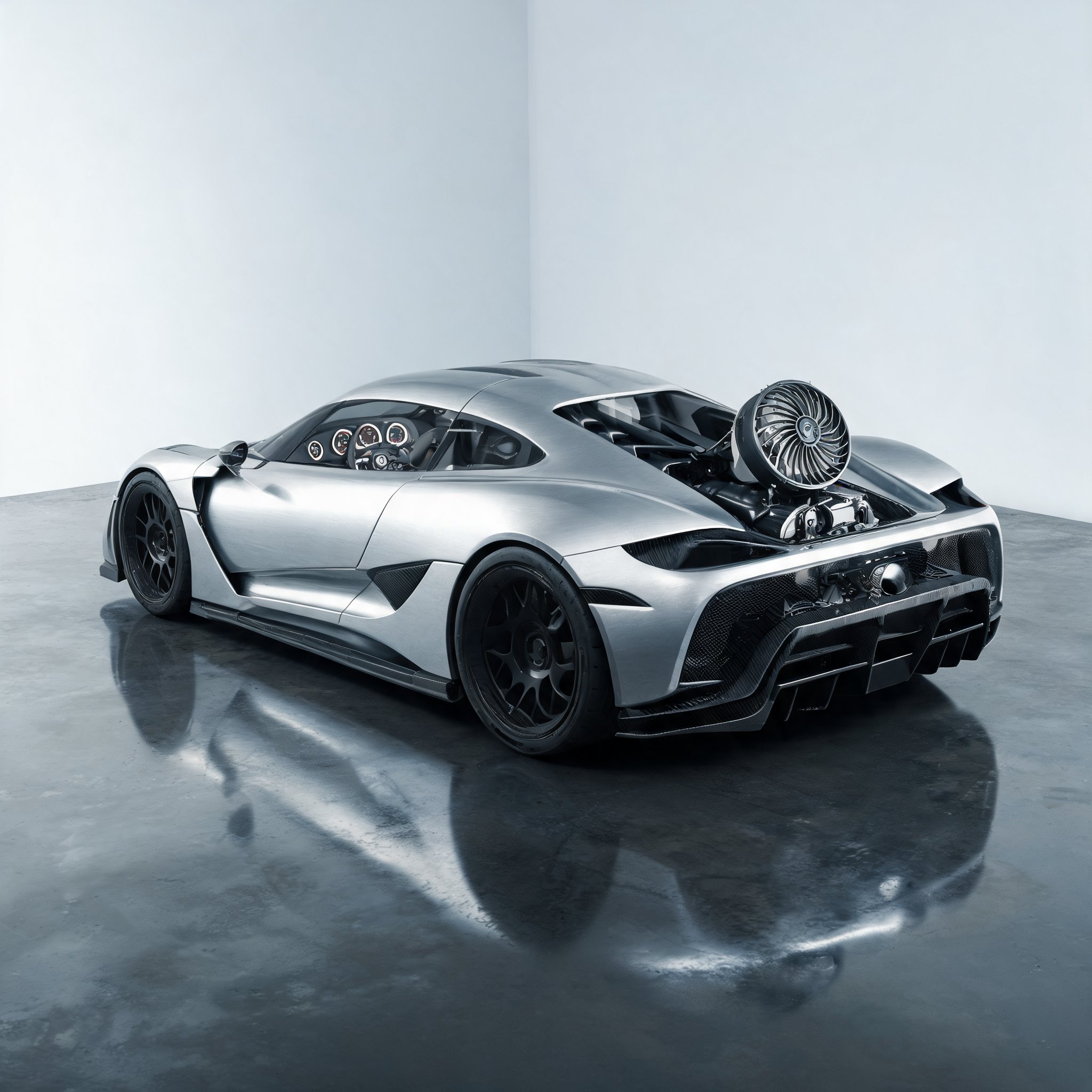
Porsche has revealed the Mission S, a mid-engine supercar that the company says will become a permanent part of its lineup rather than a one-off concept or a limited-run hypercar. The car was unveiled on Thursday, and Porsche has made clear that the production version will sit above the 911 in its range.
Placing the engine behind the driver but ahead of the rear axle is unusual for Porsche, a brand best known for rear- and front-engined cars. Its mid-engine offerings have been limited, with the Boxster and Cayman twins the best-known examples. That makes the mid-engine layout of the Mission S a notable move for the marque.
The design draws on Porsche's racing history. The flattened front end takes loose inspiration from the GT1 Le Mans racer, while the rear half carries hints of the 959. Among the most striking styling elements is a swirling radiator fan mounted atop the engine, a nod to the 917.
Porsche has not said what powertrain the Mission S will use. The company confirmed it will rely on internal combustion but deliberately avoided disclosing which engine sits beneath the hatch. Speculation has centered on a newly developed flat-eight; the German outlet Handelsblatt reported in September that such an engine was in development at Porsche. Other points in that report line up with what is known about the Mission S, including its position at the top of the lineup and a possible price of around half a million dollars. That figure is unconfirmed, though Porsche notes a 911 can be optioned beyond $300,000.
At the debut, Porsche emphasized analog engagement. A control knob resembles a manual or sequential shifter, but markings reading "PRND" next to it, along with metal paddle shifters behind the steering wheel, point to a PDK automatic transmission. Whether a manual variant will ever be offered remains unclear.
The cabin is clearly driver-focused. Controls are angled toward the driver's seat, and depending on the drive mode, the tachometer extends closer to the driver for a clearer view. Five circular gauges sit on the dash, and the key is inserted on the left, as is typical for Porsche.
Perhaps most notable is the absence of a large center screen. Porsche said it deliberately chose not to include a permanently integrated center display or a fixed passenger display. Instead, a retractable smartphone system compatible with MagSafe is designed for use as needed, letting the owner's own phone serve as a navigation or information display. The My Porsche App provides access to all functions and lets users choose digitally rendered, historically inspired designs for the circular instruments. Porsche described the result as an interior concept that puts the driving experience first while offering flexibility and convenience. Even the comfort and driving control knobs below the phone mount push in and pull out.
Much about the Mission S and the production car that will follow it is still unknown. What Porsche has confirmed is that buyers will be able to purchase a version of the car as a "permanently available super sports car offer." The company's previous concept of this kind, the Mission X, was presented in 2023 as a possible successor to the 918 Spyder.