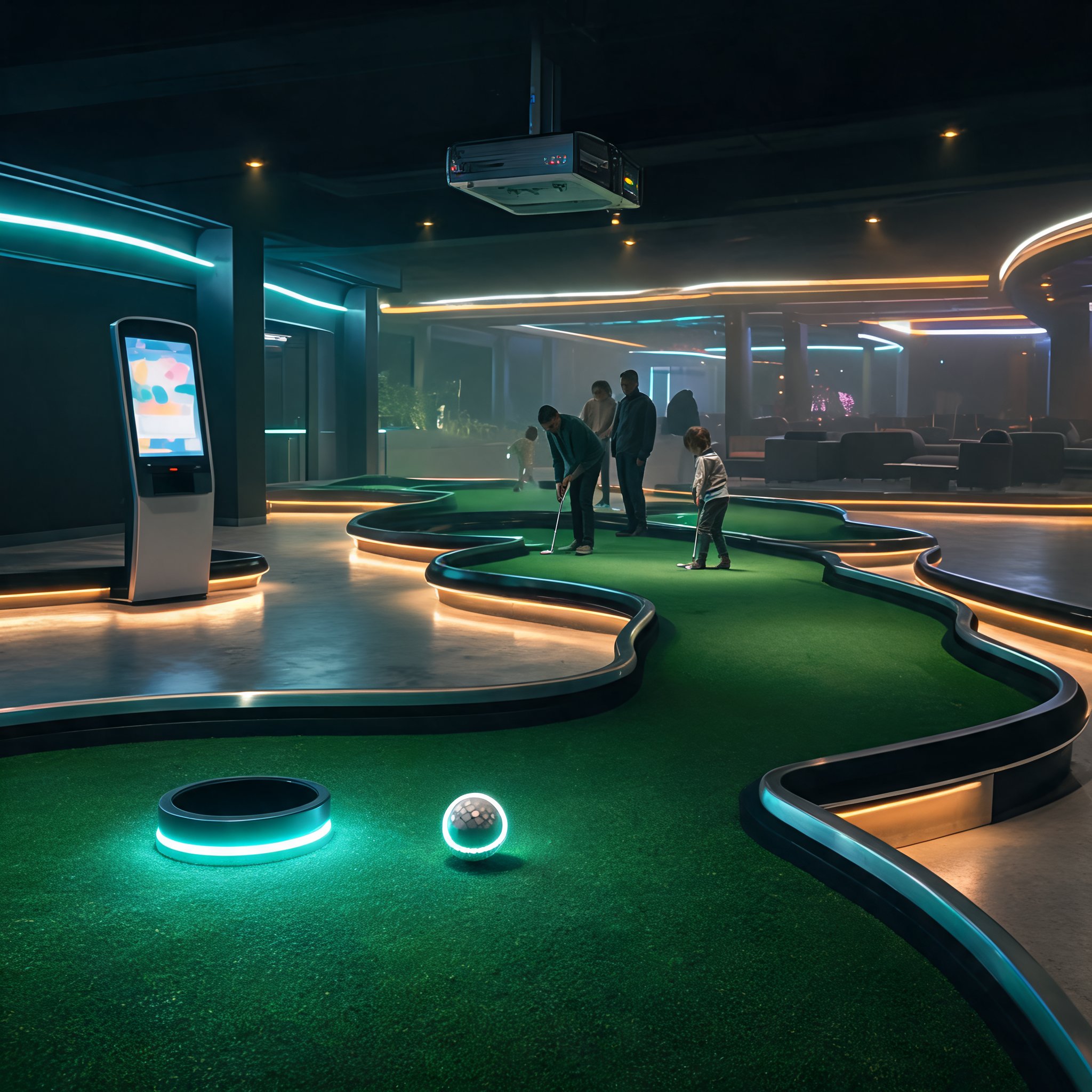
Holovis is set to present its 360Golf brand as a connected mini-golf platform rather than a standalone course. The system combines automated scoring, a layer of gamified challenges and an analytics engine for operators, and is being shown at the Land Leisure & Tourism Show in Birmingham on 4–5 November and at IAAPA Expo in Orlando on 16–20 November.
The scoring foundation is HoloTrac, which uses smart balls, tees and cups to replace paper scorecards and act as a referee during competitive play. Visitors can register, collect an assigned smart ball and start playing, an approach 360Golf says requires little explanation or staff time. The company says it is building on mini golf’s existing familiarity rather than reinventing the activity, while adding measurable commercial value. 360Golf says implementations span the UK, Europe, the Middle East, North America and Asia Pacific.
On top of scoring, 360Golf has added game features including SuperShots, which offer alternative ways to score, and Triumphs, which present awards and unlock challenges. Bonuses, on-course games, player accounts, achievements, leaderboards and video celebrations are intended to give players reasons to compare results and return. Matt Dobbs, business development director, says the features create more reason to compete, celebrate and revisit.
The DeepSmarts AI engine supplies venue operators with information on player interaction, seasonality and system uptime. Holovis says the data can support decisions on promotions and operations, and help engineers diagnose course problems remotely. The platform is designed for capacity of up to 80 people per hour per course and for secondary spending, particularly food and beverage.
Installation is structured in three broad tiers. Technology-only retrofits can be fitted into existing mini-golf attractions in about six to eight weeks; catalogue holes can be installed and ready to play in eight to 12 weeks; custom courses can take six months or more. The custom work includes the Top 9 course at Netflix House, an IP-led installation with themes such as One Piece, Squid Game and Floor Is Lava, and Tee Time for Norwegian Cruise Line, which uses marine-grade, IP-rated equipment for use at sea.
At Butlin’s PLAYXPERIENCE centre in Bognor Regis, the £15m indoor activity project opened in 2024 with three nine-hole 360Golf courses: a neon-glow course, a Las Vegas-themed course and a wheelchair-accessible music-themed course. Dobbs says the site has handled 5,000 players in a busy week and grossed around £40,000 in weekly revenue.
Other deployments show the platform’s range. Super Social in Leopardstown, Ireland, uses 12 holes from a sports-themed package; Lucky Duck in Norway has a custom course with two routes for each hole; and Saudi Entertainment Ventures (SEVEN) is using the platform as a basis for consistency across locations. Holovis is also working with Roxy Leisure to apply stroke-counting technology to crazy pool tables, extending the scoring system beyond golf.
The design options also address inclusion and throughput. 360Golf says courses can be configured for right- or left-handed play, with appropriate putter sizes and enough space between holes to reduce congestion. At Butlin’s, the team adjusted the course edge so wheelchair users can get closer to play. Holovis describes the offer as turnkey, covering course design, technology, installation and operational support rather than a course sale alone.