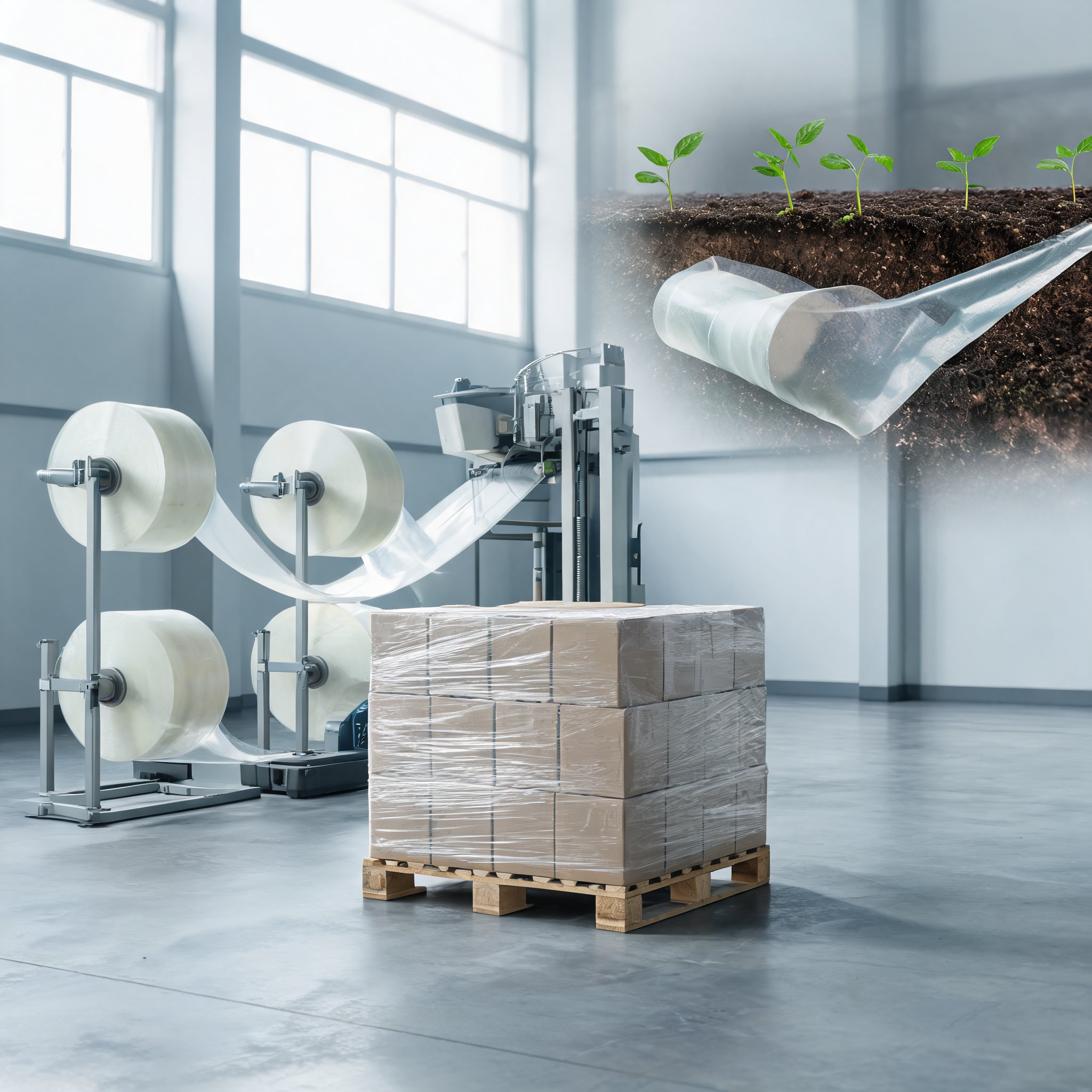
Cortec Corporation's European subsidiary EcoCortec has developed two compostable packaging films for heavy-duty industrial use. The company says EcoShrink and EcoWrap are designed as direct replacements for conventional polyethylene film in load containment and inventory staging, and can be used with existing wrapping equipment and packaging workflows. The films are manufactured at EcoCortec's facility in Croatia.
Two films for different packaging steps
EcoShrink is aimed at heat-shrinking oversized equipment and smaller components. According to Cortec, it is formulated with 45 percent biopolymers sourced from certified commercially compostable resins. When standard heat is applied, the film shrinks evenly to form a protective barrier against dust, dirt and moisture, which the company says helps protect goods during transit and extended outdoor yard storage. Cortec also says EcoShrink maintains its structural integrity under normal storage conditions and begins breaking down only when exposed to an industrial composting environment.
EcoWrap is intended for palletizing and cargo bundling. Cortec describes it as the first commercially available compostable, industrial-strength stretch film. According to the company, it is certified OK compost INDUSTRIAL by TÜV Austria under EN 13432 and ASTM D6400. A specialized tackifier formulation is used to provide the cling and stretch elasticity needed for standard automated wrapping equipment. Because of its high tensile strength, Cortec says operators can secure heavy pallet loads with fewer wraps than with conventional stretch film.
Equipment compatibility and reported benefits
The company positions both films as compatible with existing packaging lines, without machine retrofits or workflow adjustments. For EcoWrap, fewer wraps are presented as reducing material consumption per unit shipped and helping mitigate rising plastic taxes and landfill surcharges. The film is designed for commercial composting facilities, where Cortec says it breaks down alongside organic waste into nutrient-rich soil for agricultural use.
Applications and end-of-life conditions
Cortec cites manufacturing, e-commerce, agriculture and logistics operations as potential users. The company says the films offer a scalable alternative to conventional polyethylene and can allow used packaging to be routed to local commercial composting facilities instead of waste compactors. That would let packaging engineers and logistics managers pursue waste-reduction targets while maintaining load integrity and shipping protection, according to Cortec.
The environmental benefit depends on access to industrial or commercial composting infrastructure, because the films are not described as designed for home composting. The provided information also does not include pricing, production capacity or independent performance data.