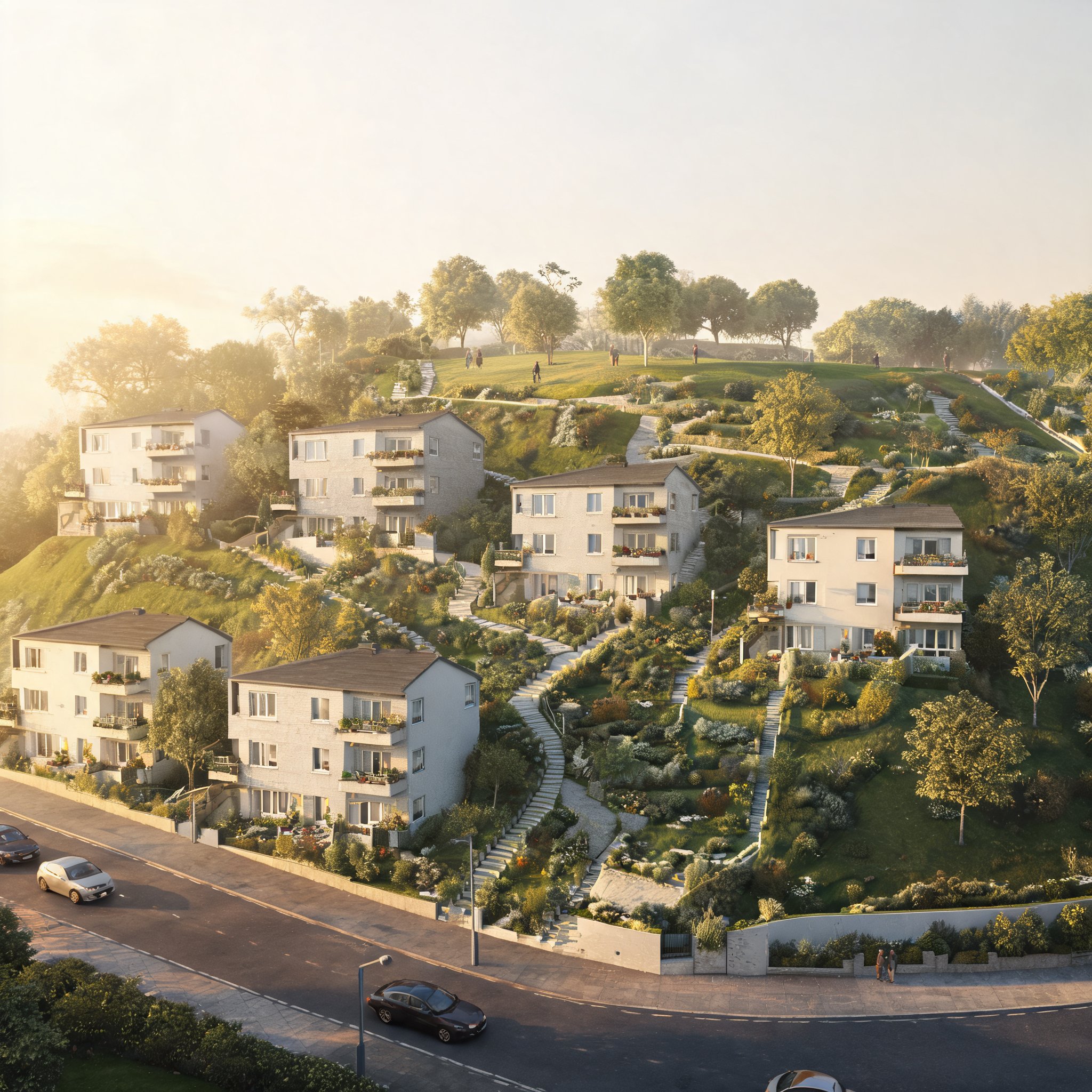
The RIBA Stirling Prize 2026 has been awarded to Lion Green Road, a 157-home council housing scheme in Coulsdon, South London. The project was designed by Mary Duggan Architects with RUFF Architects and built for Croydon Council by main contractor CField Construction under a £34m deal.
The development occupies the site of a former car park and comprises five blocks. Its sloping site changes in height by eight metres, a constraint the design team used to shape the arrangement of homes, routes and views. According to the project description, the scheme creates a new connection between Lion Green Road and an area of green parkland beyond.
Five blocks are arranged on a site that falls by eight metres. The design uses that fall and the resulting views to organise the homes and to create a connection from the road to the parkland. The scheme is described as a “living landscape” for 635 residents, with a consistent specification across the homes and subtle variation in the height and orientation of the blocks.
The design uses the site’s changing levels and views to form the living landscape. A consistent specification is combined with subtle differences in building height and orientation, an approach intended to deliver housing at scale without producing a uniform development.
The scheme also sought to reduce carbon emissions through efficient construction methods, simple finishes and a more streamlined building process. The project account links these choices to the delivery of the 157 homes on a constrained site.
Jury cites density and quality
Chris Williamson, RIBA President, speaking on behalf of the Stirling Prize jury, said that at a time when more homes are urgently needed, the project shows density can be achieved without compromising the quality of places. He described the architects as having created a new kind of garden neighbourhood that balances privacy and generous views with a strong connection to nature.
Williamson added that the scheme offers housing at scale without uniformity through its consistent specification and subtle variation in height and orientation. He called it thoughtful, resourceful architecture and said it shows that even challenging sites can be transformed into distinctive places for people to call home.
The award recognises a council housing scheme delivered through a main-contract arrangement, with the 157 homes spread across five blocks. Its former car-park site and eight-metre level change were central to the design response, which uses the topography to connect the street with the parkland and to shape residents’ views across the neighbourhood.